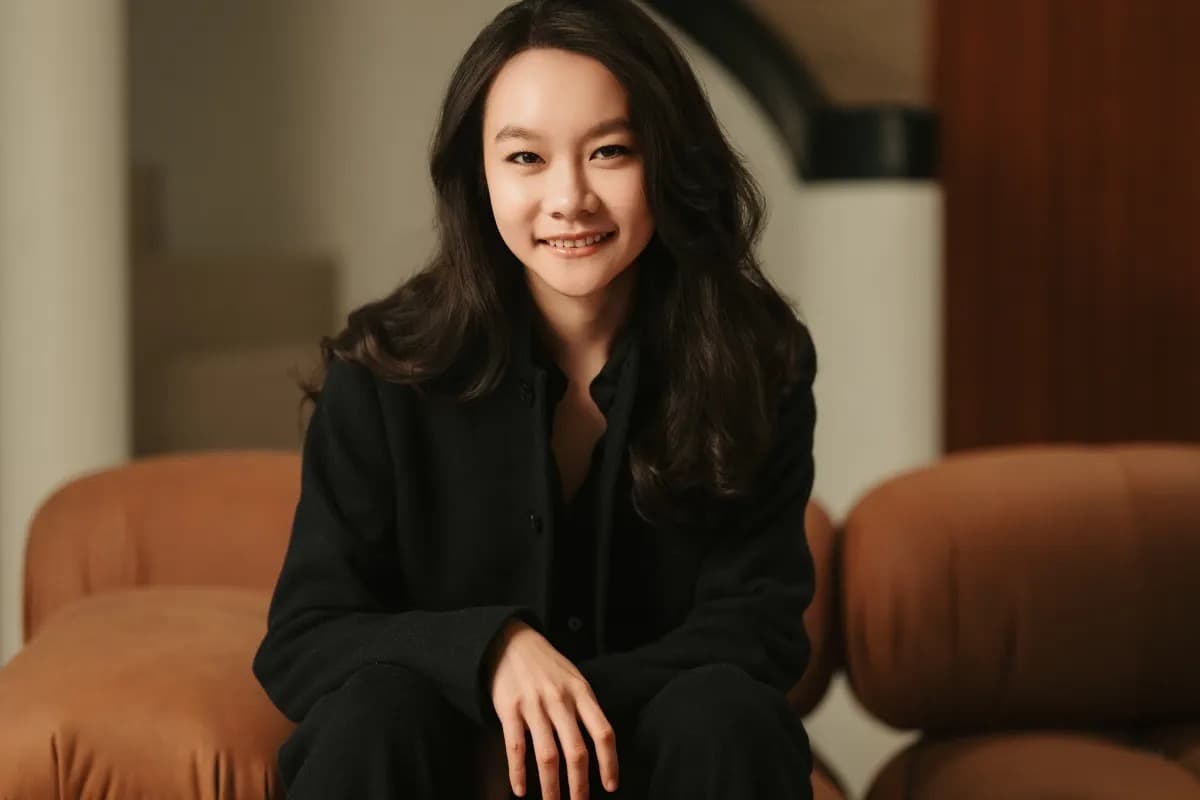
Cecilia Shen is 25 years old and already talks like someone who intends to run Hollywood rather than serve it. Her company, Utopai Studios, sits at the center of one of the most crowded and contested corners of the entertainment business, the race to turn generative artificial intelligence into finished films and television that audiences will actually pay to watch. The wager behind it is simple and enormous. Whoever masters this technology first could rebuild the economics of an entire industry.
The scale of that ambition shows up in a single line she uses to explain her strategy. You cannot become a ten billion dollar company as just a technology provider, she has said. You have to become a studio. That distinction is the whole thesis. Plenty of startups want to sell filmmakers a clever tool. Shen wants to own the films themselves.
From dropout to founder
Shen was born in China and raised in Toronto, and her path into technology was anything but linear. She left the University of Waterloo during the pandemic, spent time at the Royal Bank of Canada, and later worked at Google X, the research arm known for chasing moonshots. In 2022 she teamed up with Jie Yang, a software engineer who leads the company's research, and started building what was then called Cybever before it grew into Utopai.
The rebrand reflected a bigger shift in intent. What began as an engineering project aimed at generating digital worlds turned into a plan to produce long form entertainment at a fraction of the usual cost and headcount.
The engine under the hood
At the heart of the company is a system called PAI, a procedural content generation engine designed to solve one of the hardest problems in AI filmmaking, consistency. A designer can build a character model once and reuse it across scenes, choosing camera angles, adjusting performances, and iterating without paying the heavy cost of re rendering everything from scratch. That control is what separates a viral clip from a piece of usable, sellable film.
The tool has already found buyers. Within 60 days of its release in March 2026, licensing of PAI reached 11 million dollars in annual recurring revenue, a sign that other creators see value in the plumbing even as Shen keeps her eyes on the larger prize.
Money and momentum
The financial arc has been steep. The company reported 750 thousand dollars in revenue in 2024, then roughly 7.5 million dollars in just the first half of 2025, with the full year expected to land under 50 million dollars. Investors have taken notice. NBA star Carmelo Anthony put in a sum estimated near 5 million dollars, and the roster of early backers includes PlutoTV and Tom Ryan, the former president of Paramount Plus. The company has been valued at around one billion dollars.
The projects are getting bigger to match. A partnership with the producer Marco Weber lined up an ambitious science fiction series called Space Nation, attached to director Roland Emmerich, alongside a historical epic titled Cortes built on a script from Nicholas Kazan. Together those two projects carry a combined value near 110 million dollars in pre sold distribution, and Shen has pulled in international broadcasters including Globo TV in Brazil and ZDF Studios in Germany.
A very crowded field
She is far from alone in chasing this future. More than 65 AI studios have launched since 2022, among them Asteria Film Co., which raised 84 million dollars, along with names like Promise AI, Holywater, and B5 Studios. The competition is fierce, the technology is moving faster than the rules around it, and the creative community remains deeply split on whether any of this belongs in a real production pipeline.
What sets Shen apart is less the software and more the appetite. She is not positioning Utopai as a vendor selling shovels during a gold rush. She wants to be the one holding the finished movie, the distribution deals, and the upside that comes with them. If the bet works, she will not just have built a tool that Hollywood uses. She will have become a studio that Hollywood has to reckon with, and she will have done it before turning 30.